As General Synod prepares to consider our diocesan motion on Sustainable Church Flowers (SCF) on Thursday, Kate Hurst, churchwarden in The Shelsleys and founding member of the SCF Movement, explains why she got involved and why all churches can benefit.
Across the Church of England, there is a growing desire to ensure that the way we worship reflects the values we proclaim. Flowers have long played a cherished role in our churches and cathedrals, offering beauty, celebration and thanksgiving. Yet how those flowers are grown, sourced and arranged now matters more than ever.
The Sustainable Church Flowers motion (GS 2433A) to General Synod invites us to reflect on a simple but profound question: can our church flowers honour God without harming God’s creation?
This motion calls the Church to work with nature, not against it, celebrating local beauty while caring for the earth God has entrusted to us.
Where the Movement began, and why it matters
 The Sustainable Church Flowers movement began at parish level in the small village of Harpley, Worcestershire, when the then churchwarden, Candy Connolly, started asking questions about the use of floral foam in the Church, highlighted by her florist husband Shane Connolly MBE. It grew out of concern that some widely accepted practices, particularly the use of floral foam and imported flowers, were at odds with the Church’s commitment to care for creation.
As the Church seeks to live out its Fifth Mark of Mission, to strive to safeguard the integrity of creation and sustain and renew the life of the earth, Church flowers offer a tangible place where belief meets practice.
The principles of Sustainable Church Flowers
At its heart, the movement is not about removing beauty from our churches, but about rediscovering a deeper, more faithful beauty. The key principles include: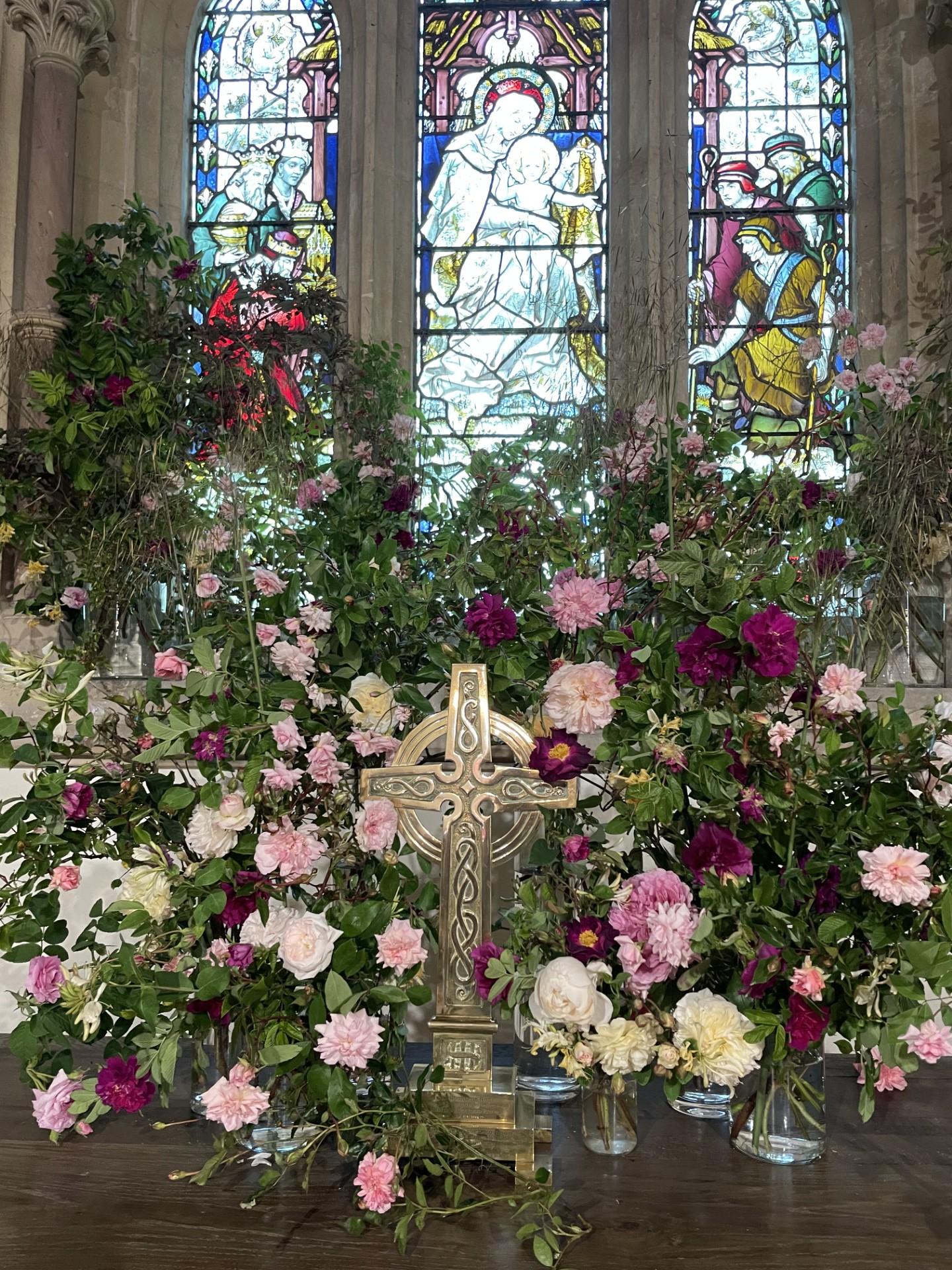
- Working with seasonal, locally grown flowers and foliage
- Avoiding single-use plastics, particularly floral foam
- Using compostable, reusable or natural mechanics
- Encouraging simplicity, creativity and community involvement
- Celebrating what God has created in the place where we worship
Why can imported flowers or floral foam cause problems?
Floral foam is widely used and can be widely harmful, so church use on a weekly basis or more, has a significant and long-lasting impact. For example:
- Standard floral foam, which still dominates sales, is made from single use plastics, is not compostable and breaks down into microplastics that can impact soil and water.
- Even alternative foams being developed are single use and have an energy footprint through their materials, manufacture, packaging and transportation, and many are not home compostable.
- A single block of standard foam contains up to ten carrier bags worth of plastic, but cannot be reused and water run off sound never go down sinks or into the earth.
“New sustainable products are coming to market to replace plastic packaging and mechanics in floristry. Many are marketed as “Bio”, “Eco” or “Natural” which sounds great, but these terms can be misleading. It is important to understand how these products are made and how they should be disposed of… There are also many DIY techniques for supporting flowers which pre-date the invention of floral foam and are coming back into wider use.”
Plastics, Packaging and Waste in Floriculture, (2024: Page 8, guidance for florists available for free at The Sustainable Flower Research Project)
Many of the flowers used in churches, bought from supermarkets or supplied by florists, can have travelled hundreds or thousands of miles and be resource intense:
- High flower exporting countries, such as Kenya, Ethiopia and Columbia, have limited water resources and flowers are thirsty.
- High flower miles can involve flights, shipping, road transportation as well as refrigeration during transit, and the need for protective packaging often plastic.
- When flowers are grown out of season, energy is often needed to heat greenhouses.
Unfortunately, origin labels and the availably of Fairtrade flowers are currently limited.
How can sustainable church flowers be achieved? Going back to basics
 Sustainable church flowers are not complicated, they are often simpler, more joyful and more connected to place.
Simple mechanics - Instead of floral foam or other single use mechanics, churches are rediscovering traditional methods. These can be effective, flexible, environmentally sound and cheaper! Such as:
- Existing or second-hand vessels with water
- Twigs and branches
- Pebbles, sand or moss from local sustainable sources
- Reusable pin holders, chicken wire (if reusable/recyclable), containers with grids
Sourcing seasonal flowers - There are many ways churches can source flowers sustainably, embracing what God has created in our landscapes and encouraging community engagement. For example:
- A donations bucket can be provided for locals to share spare foliage and flowers from their gardens or allotments.
- If churches have space useful shrubs and plants can be grown outside or in pots and window boxes for cutting and display (also useful for biodiversity).
- Seasonal greenery can often be provided locally from trees, shrubs, herbs and seedheads, by enlisting the help or access from parishioners, garden clubs, allotment holders or community garden schemes.
- When flowers do have to be bought in, building up relationships with local flower growers can be useful and many offer ‘church buckets’, which you can find via national networks such as Flowers from the Farm and the British Flower Market. These sources can also be useful to suggest to those having events in church, so they know their options.
- Always seek flowers with information about where and how they were grown, and asking your florist for seasonal flowers can also be useful for strengthening demand for seasonal, local flowers and can support rural economies too.
Help, resources and support - Churches do not have to do this alone, indeed many have years of experience working in this way, including my own. It also does not have to happen overnight. The SCF movement is rooted in generosity and shared learning, not perfection.
 The SCF national network of Floral Ambassadors and Clergy Ambassadors can offer guidance, encouragement and lived experience to churches near them
- The SCF website provides practical guides, tutorials on foam-free mechanics, seasonal flower and shrub growing suggestions, case studies from churches already making the change, and templates that can be used for PCCs and guidance to offer those organising events in church
- The national SCF Scheme to encourage and acknowledge sustainable use of flowers, at Supporter, Advocate and Champion levels is available to all places of worship
A hopeful step towards sustainable worship
 The debate surrounding the Sustainable Church Flowers motion has prompted important and sometimes challenging conversation across the Church and beyond. Yet at its heart lies something simple and hopeful: a shared desire that the way we adorn our churches reflects the care and reverence we hold for God’s creation.
This commitment is deeply rooted in the Fifth Mark of Mission. Sustainable practices do not diminish beauty; rather, they invite us to honour creation more thoughtfully, ensuring that what we offer in worship is life-giving in every sense.
Questions have been raised, sometimes shaped by misunderstanding about floristry materials or practice, or the aims of the Motion itself, and these have been met with care and openness. The ongoing conversations remain grounded, practical and pastorally aware of the realities facing parishes of all shapes and sizes.
The Church is at its best when it grows with courage and gentleness: attentive to evidence, rooted in hope, and willing to model the change it seeks in the world. Sustainable church flowers provide a unique opportunity to do this and SCF exists to support that journey, encouraging approaches that are environmentally responsible, creatively enriching, and faithful to the gospel we proclaim.
A faithful, hopeful step forward with Synod
This motion does not mandate uniformity, nor does it ban anyone from doing anything. It invites creativity, discernment and local response. It reminds us that beauty and sustainability are not opposites, they belong together.
By embracing sustainable church flowers, we honour God not only with what we place on our altars, but with how we care for the world beyond them. Together, even in the smallest details of our common life, we can offer a quiet but compelling witness to the God who both creates and renews all things.
For more information, support and shareable resources, please see these links:
- The Sustainable Church Flowers Motion at General Synod
- The Sustainable Church Flowers Website with downloadable resources Sustainable Church Flowers YouTube with free videos
- Sustainable Church Flowers Instagram with videos, updates and inspiration
- The Sustainable Flowers Research Project with reports and latest research