All Christians have a vocation - a calling from God to follow and to serve as his Christ's disciples.
Some people, though, find themselves increasingly feeling themselves called to take a particular responsibility of God's Church by becoming ordained ministers. This is a very public ministry: ordained men and women are very often the ‘public' face of the Church that we see.
Such a calling needs testing. It isn't enough to believe yourself to be called by God to be ordained. The Church takes time to discern with you whether this is, indeed, your particular vocation.
Those who will try to help you discern whether you have a vocation to ordained ministry will want to be able to answer two fundamental questions:
- Is this person called by God to ordained ministry?
- Does he or she have the necessary gifts to undertake such ministry?
Nine criteria for ministry
In order to help answer these questions the Church uses nine 'criteria' for ministry. These cover various aspects of your life and faith, not only your sense of vocation, but also your relationship with the Church of England, your spirituality, relationships, ability to lead and work with others, your personality and character, your quality of mind, commitment to mission and evangelism and the nature of your faith.
These criteria can be found in more detail on the Church of England website.
Taking the first steps to Ordination
The first step is taken within the diocese. The Diocesan Director of Ordinands takes time to meet with you and discuss your faith and your sense of calling in the light of the nine criteria.
She will also discuss some of the practical issues about ordination, answering questions such as ‘Can I be ordained if I've been divorced?' ‘How will this affect my family?' ‘What sort of ministry might I exercise if I'm ordained?' This is a long process - some people are surprised that it seems to take so long, but discernment is not something that can be done quickly.
Bishop's Advisory Panel
If the DDO believes that the answer to the two questions above is ‘yes' then she will refer you first to the Bishop, and then to the discernment process that takes place at a national level. This involves attending a Bishops' Advisory Panel (BAP).
A Panel takes place over four days and is quite an intense experience! Candidates are interviewed by three Advisers, they give a short presentation, chair a discussion and offer two written pieces. It is also a very prayerful experience: the Advisers are seeking the guidance of the Holy Spirit and the days spent at Panel are surrounded in prayer.
If you are recommended for training following a Panel, you train for a period of usually two or three years, either part time or full time. The training ‘pathway' is worked out with the DDO. Training is not simply about acquiring the ‘skills' to be ordained, but is known as ‘formation' because it is about being ‘formed' for ministry. So again, it involves a lot of prayer, as well as essays and placements.
Being ordained as deacon
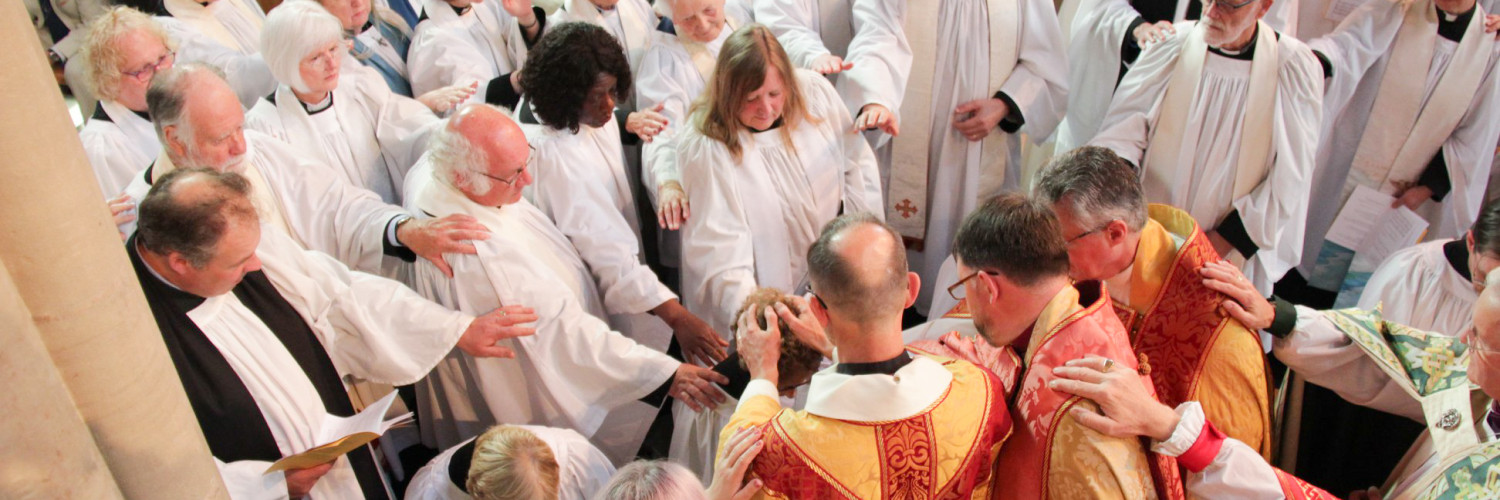
After this period, following a satisfactory report from your training institution, you are ordained deacon. A deacon begins to serve as a newly ordained minister in a parish, working with a supervising colleague - usually the vicar. After a year as a deacon, and following a satisfactory report, a deacon is normally (although not always) ordained as a priest.
After ordination
After ordination, newly ordained ministers (curates) continue in training. This takes place in the large part in their parishes, but they meet with the DDO through the year to reflect together on ordained life. They learn about ministry in different contexts - for example, in hospices, in rural areas, in industrial centres, in prisons.
They reflect on working with children and vulnerable adults, on the history and theology of the Church, on teamwork. They support one another in ministry as they learn and think together. This is known in the diocese as Initial Ministerial Development, and it dovetails with Continuing Ministerial Development, in which all clergy take part.