
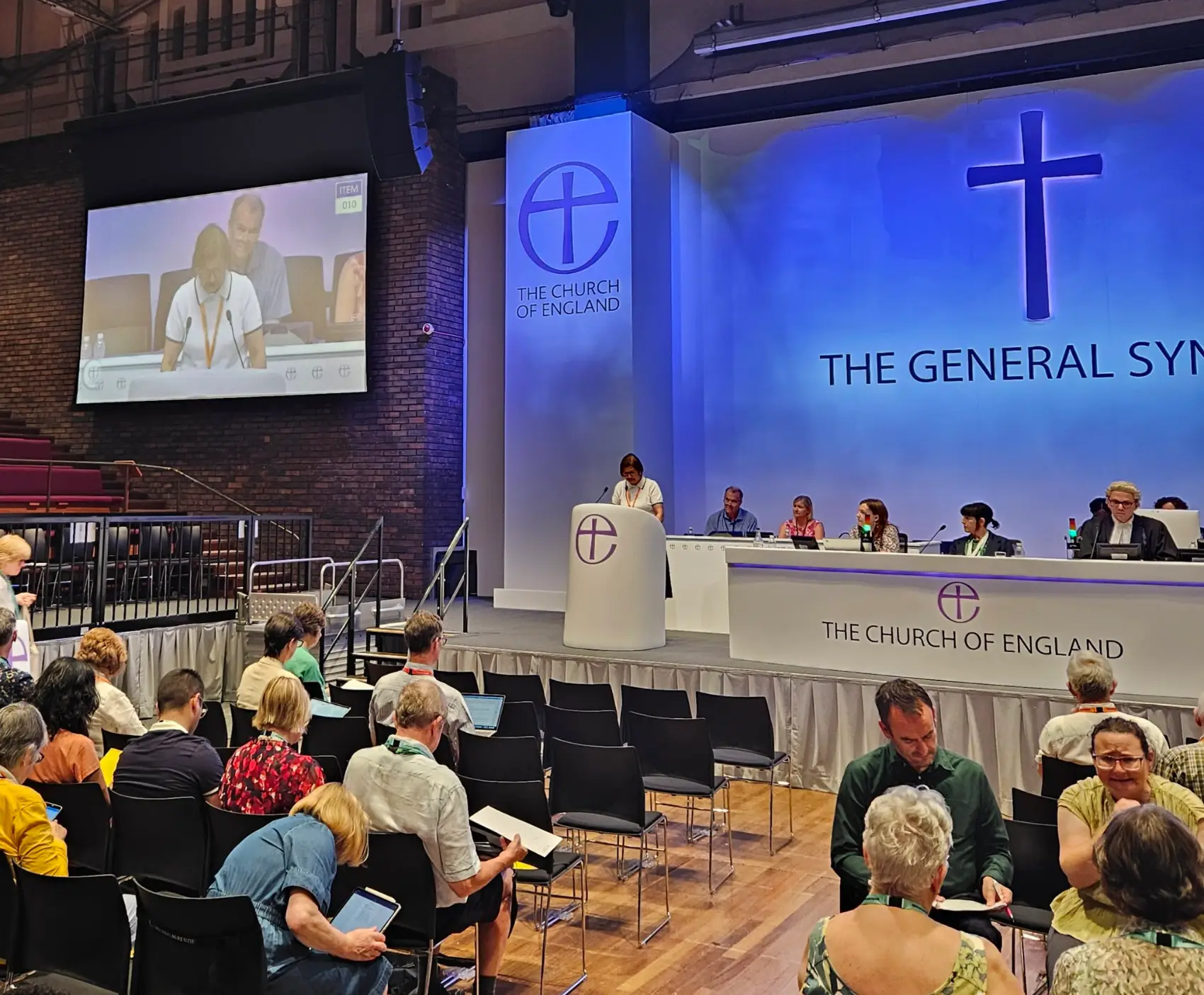
The Church of England’s General Synod was dissolved on Tuesday 14 July 2026, formally ending the term of its current membership. Elections to form the Synod for the next five years will be held in each diocese from 14 August.
Timeline for the elections
- 14 August – nominations open (any member of a deanery synod can be a nominator)
- 7 September, 5pm – nominations close and candidates must have submitted their profile documents.
- 9 September, 7- 9pm – Hustings for the House of Laity chaired by Diane Cooksey (On Teams with a room available in the diocesan office for anyone who wants to attend but doesn’t have access to the relevant technology)
- 10 September, 7 – 9pm – Hustings for the House of Clergy will be chaired by Hugh Richards (On Teams with a room available in the diocesan office for anyone who wants to attend but doesn’t have access to the relevant technology)
- 21 September – voting opens (lay members of deanery synods can vote for lay candidates and all licensed clergy are eligible to vote for those standing for the house of Clergy). Information about each candidates will be available on the diocesan website.
- 13 October – voting closes
- 19 October – results announced
Almost anyone who attends church regularly is likely to be eligible to stand as a lay member of General Synod. You don’t need to be a member of a PCC, Deanery Synod or Diocesan Synod.
We are looking for candidates who represent the whole range of people and churches in the Church of England. We particularly welcome candidates whose background may currently be underrepresented.
There is a supportive induction programme to help new members in their roles.
Read more about why you might wish to stand
Visit the Church of England’s Synod elections page
For more details or to confirm your eligibility to stand, contact Judith Nex or Andy Todd
Candidates standing for the House of Laity
(click on the name to download their election address)
Candidates standing for the House of Clergy
(click on the name to download their election address)
See the questions being asked of candidates at the hustings (and answers when available)
Useful documents:
- Nominations form – laity
- Nominations form – clergy
- Election rules – laity
- Election rules – clergy
- Future dates for general synod
- Young adults at General Synod
- General information on meetings of the General Synod, Committees and Commissions
Further information for Deanery Synod members
All members of Deanery Synods are on the register of electors and therefore can be a nominator for these elections. The election process (including nominations and voting) will be run by Civica Election Services using an online portal, however for those who wish to use a paper-based system this will still be possible; voting will take place using the single transferable vote (STV) system.
If you have provided an email address, nomination information will be emailed to deanery synod members on Friday 14 August from the following address: generalsynodelections@cesvotes.com. Please note that the email from Civica will include a login link to the portal which is unique for your own use. You must not forward the email to other potential nominees, but instead ask them to contact elections@cofe-worcester.org.uk to receive their own login code.
If you believe you should have received voting information and haven’t, please do also contact us on elections@cofe-worcester.org.uk.
Information for all electors
· Your name and postal address will be automatically included on a register of electors unless you instruct the Presiding Officer in writing. The postal address is The Diocesan Office, 16 Lowesmoor Wharf, Worcester, WR1 2RS or email elections@cofe-worcester.org.uk This could be because of personal circumstances (if for example you have been a victim of stalking or other harassment).
· Please note that your name, postal address and email address will be provided to any candidate standing for election who requests those details, except if you have instructed me as Presiding Officer that it must not be included (see above). These details can only be used for election purposes and candidates are advised that these details must be deleted after the elections.
· As an elector, you will normally be qualified to stand as a candidate in the election. There are various grounds contained in Part 7 of the Church Representation Rules under which someone may be disqualified from standing for election. A person is disqualified from being nominated or elected or from serving as a member of the General Synod if the person holds or takes a paid office or employment the appointment to which is, or may be, made or confirmed by —
- (a) the General Synod,
- (b) the Convocations,
- (c) the Archbishops’ Council,
- (d) the Church Commissioners,
- (e) the Church of England Pensions Board, or
- (f) the Corporation of the Church House.
· A person is also disqualified if they are included in a barred list under the Safeguarding and Vulnerable Groups Act 2006 or have been convicted of an offence mentioned in Schedule 1 to the Children and Young Persons Act 1933.
· Those wishing to stand for election may wish to know that Synod members will be reimbursed for travel, accommodation and subsistence expenses for meetings held in London, and travel for meetings held in York (as the diocese will be billed directly for your accommodation and meals). If you are not able to pay up front for these things, we will work with you to ensure this is not a barrier to you serving on General Synod.
· Potential candidates may also wish to know that the 2025/26 rate of compensation set by the Archbishops’ Council for loss of earnings due to attendance at General Synod or at meetings of the Synod’s or Council’s subordinate bodies is the actual loss up to £210 per day of absence.