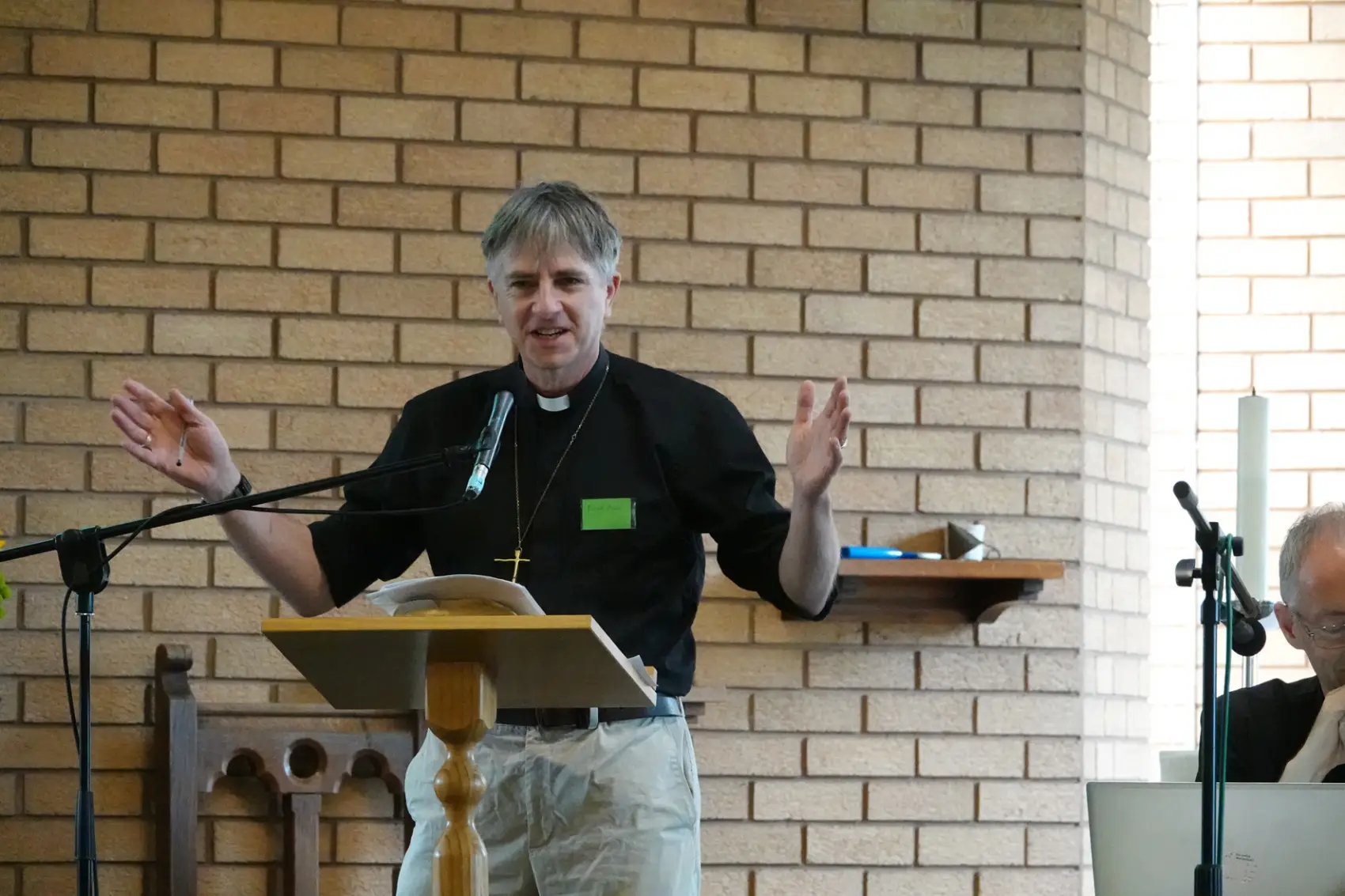
At a meeting of the Diocesan Synod on 6 July 2026, Bishop Hugh gave the following address:
In a moment I want to talk about the word that I have heard more often than any other in the 6 months I have been out and about in the diocese.
Before that, a quick word about what I think these Synod addresses are for. Synod literally means the ‘shared way’. It’s one of the places where we – as ‘the diocese’ – are reminded that we are called to walk the way together, and where we decide how best to walk the way of Jesus – who is The Way. And tonight, in particular, that means looking at the annual report and accounts and deciding whether they give an accurate account of the way we have walked together this last year.
So whenever I speak at Synod I’ll be asking – what am I noticing about ‘the way’ we are walking? Are we walking it together? Is it Jesus’ way? What is blocking the way? What ways are opening up, or being closed, ahead of us?
And this evening I want to explore the one word I have heard more often than anything else as I’ve got to the know the way that we are travelling together in the diocese at the moment. And it’s the word ‘busy’.
I notice that, when people speak to me they almost invariably say – ‘you must be so busy’ or ‘I’m sure you’re too busy for…’. Or ‘I’m too busy’ or ‘We are such a busy church’ or ‘We’re all too busy’ or ‘If only we were not so busy.’
In Scripture, the simplest way to find out what matters most in a book or passage, is to count what said most frequently. So, as an example, we know that the Kingdom mattered to Jesus because he uses the word 126 times. And the same is true for any family, community, organisation or diocese. When the same thing is said over and over again, in different contexts and settings, we can be sure that it matters.
I wonder if you recognise what I have been hearing? ‘We’re too busy.’
Now, before I get into some thoughts on why we’re so busy and what we might do, I need to note two things.
First, there was no golden age when people did not have more to do than time to do it. Life as a 15th century farm labourer in Worcestershire or a 19th century factory worker in Dudley was exhausting. And more than sixty years ago American comedian Frank Clark could write, “Modern people are frantically trying to earn enough to buy things they’re too busy to enjoy.”
Having too much to do is not new, and there was no Golden Age for us to be nostalgic about.
Second, this is not a challenge just for the church – speak to teachers, nurses, social workers or care workers – let alone someone holding down three jobs in the gig economy, and they will say the same. The experience of being too busy is widespread.
But it is clearly the case that many people in the church experience themselves, and experience our shared life, as being too busy. And we must take that seriously. In fact, I have chosen to talk about this, rather than all the other things that I could have picked, because I think we need to take it very seriously indeed.
And there are real questions about what is expected of churches – and schools, and every other kind of organisation – in governance, management and reporting. And I want us to look at that carefully – more of which another time.
But it isn’t just that. In fact I don’t think that’s the key cause of our busyness. Instead I want to suggest three bigger causes. And in doing so, I want to suggest that the challenge is fundamentally a spiritual challenge. And then I want to offer four practical responses. And I offer these as the first word on the subject, and certainly not the last, and I hope at the very least that this provokes more conversation about our sense of overwhelming busyness.
First, I think we have come to see busyness as a marker of value. Being busy means you are contributing, that you are productive; that you are worthwhile — or at least giving that impression. In a culture that so often defines us by what we produce and consume, busyness has become a sign of status.
Academic, Professor Jonathan Gershuny, an expert on social habits, including the experience of ‘busyness’, puts it like this ‘You ask me, am I busy, and I tell you: ‘Yes, of course I’m busy – because I’m an important person’. Busyness has become the indicator of high status”
But I note that Jesus never said ‘blessed are the busy’, nor is busyness one of the fruits of the spirit. Patience is, and gentleness. Joy, peace, faithfulness and self-control – they make it onto the list, but efficiency, busyness, productivity – none of them are there.
But busyness has become the indicator of status.
Second, we are overwhelmed by information and by choice. Social media and the internet place more before us than we can possibly absorb, while our culture tells us it is down to each of us to make the right choices and live our best life. That pressure is bad for us and leads either to self-hate, or to blaming others – and we see plenty of both of those at the moment.
And Jesus said (something like), ‘Look at the birds of the air; they do not need to make choices that maximise their experience of life, and yet your heavenly Father feeds them. Are you not much more valuable than they? And see how the flowers of the field grow. They do not spend hours on social media, bombarded with information. Yet I tell you that not even Solomon in all his splendour was dressed like one of these.’
Finally, and most importantly, I think the real cause of our busyness lies not in our diaries, but in our hearts. In Scripture, the heart is where the battle for control of our lives takes place: who sits on the throne of your heart? Is it The Lord, or one of the many little lords — money, status, power, cynicism, anger, fear — that would like us to kneel before them.
When we welcome the real King to sit on the throne of our hearts, we know, in some deep-down way, that God has given us everything we need and that, while there is much for us to do in partnership with him, we are not ultimately in charge.
When we allow other little lords to take the throne of our lives, we are conned into believing that God isn’t enough and that we live in a world of scarcity, and that we have to make it all work; that it’s all on us, and our hearts become frenetic places, full of busyness and anxiety.
Walter Brueggeman, the great American theologian put it like this ‘our exhaustion is rooted in anxiety that mistrusts the abundance that God has ordained into creation.’
God has given us enough. We are invited to join him in stewarding what has been given and sharing what we have received. But we are not called to save the world or the church. That is God’s job, and in Jesus, he has already done it.
Now, none of this means we don’t have more to do than time to do it, nor that the experience of being overwhelmingly busy isn’t a serious problem, which harms our bodies, our relationships and our faith.
But the answer will not be found simply in better organisation, less paperwork or sharper strategies.
So, what to do?
Here are four suggestions.
Number one, remember that God is God and we are not. Hope comes from God, not from our own restless busyness, and all purposeful activity – the kind that leaves you both tired and fulfilled – comes from hope.
That truth is the foundation, purpose and destination of all of us who follow Jesus, and the disciplines of prayer, worship, community and self-giving service are how we allow God to take His place on the throne of our hearts.
Training for ordination I was taught that every Christian – especially Christian leaders – should have these words written somewhere they will seen every day– ‘There is a Saviour. Thank God it’s not you.’
Number two, the words we use matter, and the things we value matter even more. So take away the value we give to the word ‘busy’ by refusing to use it. Then value other things instead. Like prayer, compassion, service, hope and joy.
That also means remembering that the alternative to busyness is not laziness. The alternative is purposeful boundaried activity, followed by Sabbath.
On which subject, number three – ‘Remember the Sabbath and keep it holy’ is the fourth of the 10 commandments. We are very clear that murder, adultery and theft are all wrong – but somehow keeping the Sabbath has become an optional commandment for when we have time. But the point of the Sabbath is to rest and to be reminded that God is responsible for the world, not us, and that he can do just fine when we stop and do nothing.
Number four, individually and as churches, do a few things, and do them well. There always are, and always will be, more possible activities than time to do them. But you cannot do them all, so discern carefully by listening to God, your communities and each other, then make the necessary choices and commit. And remember that ‘no’ can be a good and godly word.
- Remember that God is God, thank God, and that we have been given all we need.
- Stop using the word ‘busy’
- Keep the Sabbath
- Do a few things and do them well.
Those are my opening suggestions in the profound spiritual work that is needed if we are to be the communities of faith, hope and love that we are called to be. You will have other thoughts too – and I hope you will share them as they strike you.
Above all though, my hope is that in the midst of all we have to do; the decisions, the needs around us, the possibilities before us, we remember who we are; Kingdom People, called to live the way of Jesus together in this beautiful, broken world, and given everything we need to be who God needs us to be.
Or, as Jesus put it ‘Seek first his kingdom and his righteousness, and all these things will be given to you as well. So do not worry about tomorrow, for tomorrow will worry about itself.’
Amen