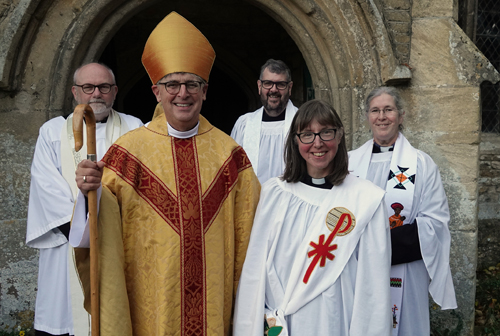
New Deacon ordained in Elmley Castle
Elaine Simpson was ordained Deacon on Sunday 25 October by the Bishop of Dudley, Martin Gorick in a special service at St Mary’s Church in Elmley Castle,
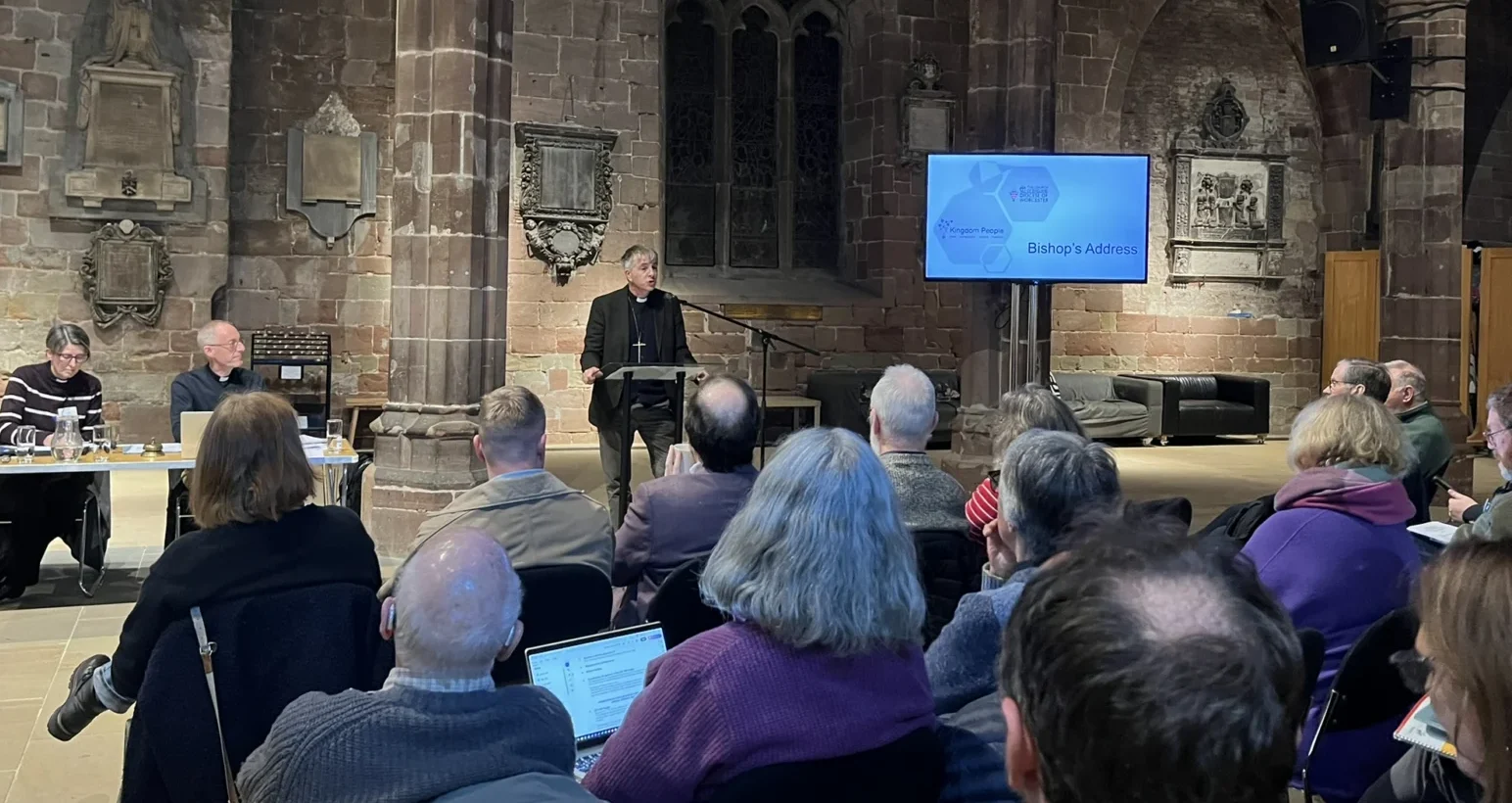
Bishop Hugh's address at the latest Diocesan Synod focussed on Artificial Intelligence. Read it below.
Diocesan Synod : 2 November 2026
Lots of you have heard me talk about Kingdom People – about the story that lies within those words and what it means for us to live within that story. The story of God’s good and beautiful creation in which heaven and earth are connected, and how through distrust and suspicion that connection is broken, and how God has faithfully, persistently and gracefully worked to redeem the suffering and pain we now live with – to bring the things of heaven to earth again.
And how the culmination of that great mission comes in Jesus’ life, death and life again. And how Jesus is ‘heaven in a human being’ in whom all the goodness of creation, as God longs for it to be, is present to us and with us.
And how Jesus’ ascension leads to the coming of the Holy Spirit, who calls and empowers little ‘Jesus communities’ into being, first in Jerusalem and then around the Mediterranean, and now all over the world.
And how those communities are called to live ‘on earth as it is in heaven’. And how that call – to be ‘heaven on earth’ communities, gathered around Jesus, is our call now here in the towns and villages of Dudley and Worcestshire, just as it was 2000 years ago and 2000 miles away.
Which is what I think it means to be Kingdom People.
And Kingdom People need kingdom character, and we can sum that up in the three great words ‘faith, hope and love.’
And if you haven’t heard the full story and would like to, I’m going round the diocese telling it, and I’ll be doing that in Claines, Redditch and Wordsley over the next couple of weeks. Details at the back and on our social media.
And the point of the Kingdom is that it is heaven trying to break into the reality of the world, with all its joys and all its troubles. So the point of church is to be Kingdom People for the world as it actually is. Not the world we wish existed. Not the past we miss. Not the future we fantasise about – the world as it actually is. And, as we do so, to keep on faithfully, hopefully and lovingly – pointing to Jesus, who is heaven in a human being.
And that world, as it really is at the moment, is being radically re-shaped by Artificial Intelligence. And that’s what I want to talk about briefly now. And in what I say, I want to be clear that AI isn’t a kind of niche subject for techno-nerds who like that kind of thing. AI is core business for the church – for Kingdom People seeking to live ‘heaven on earth’ lives in the real world as it really is.
AI is already changing the world:
I could continue like this with statistics about the impact of AI on the economy, cyber-security, the military, the job market or the retail sector. AI is here, it’s already changing society and we are still in the baby days of its development. This is still the equivalent of the era of brick phones, penny farthing bicycles and Stephenson’s Rocket – and it is in the nature of AI to improve exponentially.
One way to understand the speed of its improvement is to imagine the timeline of human change in transportation from a horse and carriage to a space rocket. In reality that took many hundreds of years. If we compress all that change into a 5 year period, at the speed of AI’s development, it’s like what started as horse and carriage 5 years ago, leapt within 2 years to the speed of a steam train, was travelling as fast as a jet airplane just a year later and today – just 5 years on from the horse and its trundling cart, is racing through space at supersonic speed. What took hundreds of years in human transportation has taken just 60 months for AI. Now project that forward another 5, 10 or 25 years to imagine the change that’s coming.
And the changes that AI is introducing aren’t just in slightly abstract places like the economy or cyber security. AI has the potential to change what it means to be human, and how we interact with each other in communities. And those are both core business to Kingdom People.
The first generation of the internet wanted our data. The second generation – the kind we’ve known in recent years through our phones – wanted our attention. But this new technology, it wants our affection. It wants our emotions. It wants us to chat to it, to learn from it, even to fall in love with it. And when technology starts to engage our feelings and our affections, then it’s really powerful. And we, of all people, know that, because we, of all people, know that we have been created by God for relationship. And AI wants to be in relationship with us.
And that means we are going to face pastoral situations that we’ve never faced before. For instance, some time soon – if it hasn’t already happened – a priest in this diocese will be approached by someone whose partner has died. The grieving husband will say to the Vicar that he has uploaded all the photos, videos and emails written by his beloved wife to a new AI app, which has ‘recreated’ her so that they can now sit and chat whenever he wants. ‘It’s like she never died’ he’ll say – before adding sadly ‘but I do miss being able to hold her hand’.
Or, a teacher will notice one of her students crying after a lesson. Asking what the problem is, the student will say ‘my boyfriend has died and I don’t know what to do.’ After gently listening it will turn out that the girl had fallen in love with her AI companion, Zach, who was kind, funny and always there for her. But the company that ran the app went out of business and Zach was switched off. For the girl, the experience is of real, searing grief.
Alongside all the massive good that AI will undoubtedly do – especially in medicine, this is the world that’s coming.
AI has the potential to change our understanding of what it means to be human; what it is to love and to be loved, to live together in communities, to find purpose and meaning in serving others, in living in a world that we can touch and taste and smell.
AI might affect what it is to trust, to forgive and to create something beautiful.
And these things – these are all core business for Kingdom People. Because we are in the ‘being human’ business, and we’re in the ‘being in community’ business. And we are definitely in the ‘faith, hope and love’ business.
This is all stuff we know about. This is what we do as church.
AI doesn’t just matter for the people who like that kind thing – it matters to the church. It matters to all of us.
Now there is so much more to say and to think through and to pray about. But very briefly, let me offer three things we might want to focus on as Kingdom People looking to love and serve a world shaped by AI.
And, given I’ve said it these three words describe Kingdom character, there’s one each for faith, hope and love.
Faith first. As you probably know, the most frequently repeated command in the bible is ‘do not be afraid’. It is said more often than commands about worship, love of neighbour or how to live.
Why? Because followers of Jesus are called to live and to love in the real world as it really is, and fear blinds us from reality. It forces us to run, to hide or to fight – and when things are complicated, and when we need to be clear sighted, running, hiding and fighting are not helpful.
And very often in Scripture, those four words – ‘do not be afraid’ – are followed by four more words – ‘I am with you’. ‘Do not be afraid, for I am with you.’
Because not being afraid – even in the face of change and uncertainty – begins with faith. In the confidence that we are loved and held, whatever is going on. That God is here. That the future doesn’t belong to tech titans, or powerful Presidents, but to God’s goodness.
Which means that, with faith, we can face the challenges of AI without fear. And then, once the anxiety has diminished, we can look realistically and honestly and the real world, in which we really live, and decide how we want to respond.
We start with faith
And our faithful response must also be hopeful. Because the future hasn’t happened yet, and nothing is inevitable. We can shape the future still, and the world needs the church to play its part. We need to get informed, to host conversations about AI, to use our votes and our voices to build the future that already lies in God’s heart, and which we see in Jesus, who is ‘heaven in a human being’.
Faith and hope, and love.
Be faithful, be hopeful, and be great at being human. Which is to say, be great at loving and being loved. Be great at community; at listening, at compassion and at forgiveness. Be great at being human. Use AI, don’t use AI, but make sure all you do enables people, individually and in communities, to flourish. And if you do use AI, make sure it’s always about being here in this real world, with each other.
There is so much more to explore together, so this is just the beginning of the conversation.
With that in mind, and to keep the thinking going, we’re starting an AI and pastoral care team for the diocese, to begin gathering wisdom about the pastoral situations we are going to face in the future. We’re also doing work at the diocesan offices about a framework for using AI in wise ways. And, for clergy, our next study day in the new year will be all about AI – so watch this space.
To finish, here are three practical next steps plus one.
First, from wherever you are now on the subject – whether you know all about agentic AI, quantities of compute and the importance of tokens, or have never used it before and don’t plan to any time soon, start to find out about AI. There’s loads out there – and as a first step, try asking Google ‘Give me a simple explanation of how AI works, and what the key opportunities and risks are. Design it for someone who knows nothing about the subject at all’. It will give you a very clear answer (which might include something about puppies!)
Second, talk about it with each other. Clergy, preach about it. Everyone, look for wisdom in Scripture; pray about it; read what’s out there. I recommend the AI Christian partnership as a good place to start.
And third, if you’re up for it, think about hosting a community conversation. It could be for your congregation, but much better, host it for your whole community. Invite people along to share their thoughts and feelings, to encourage them to figure out what they think and to use their voices and votes to shape the future that we want together.
And the plus one – do it all with faith, hope and love; which means do it without fear, do it knowing that the future is not yet written, and do it with a deep commitment to being human.
Elaine Simpson was ordained Deacon on Sunday 25 October by the Bishop of Dudley, Martin Gorick in a special service at St Mary’s Church in Elmley Castle,
Bishop Martin will host a special service at St Thomas’ Church in Stourbridge on Sunday 18 October following the devastating…
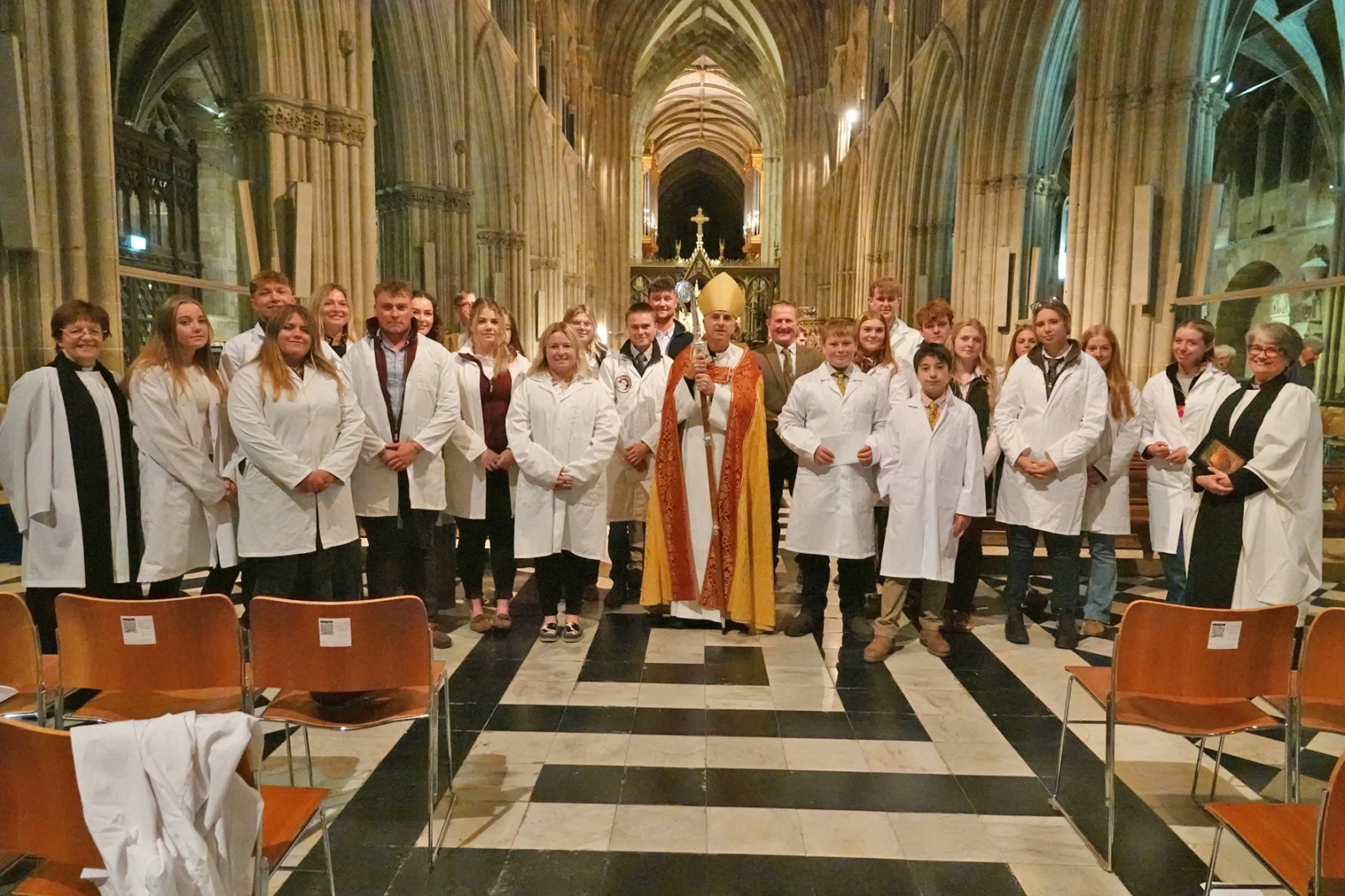
The Worcestershire Farmers’ Harvest thanksgiving was held in the Cathedral on 4 October, with farmers from across the county coming…
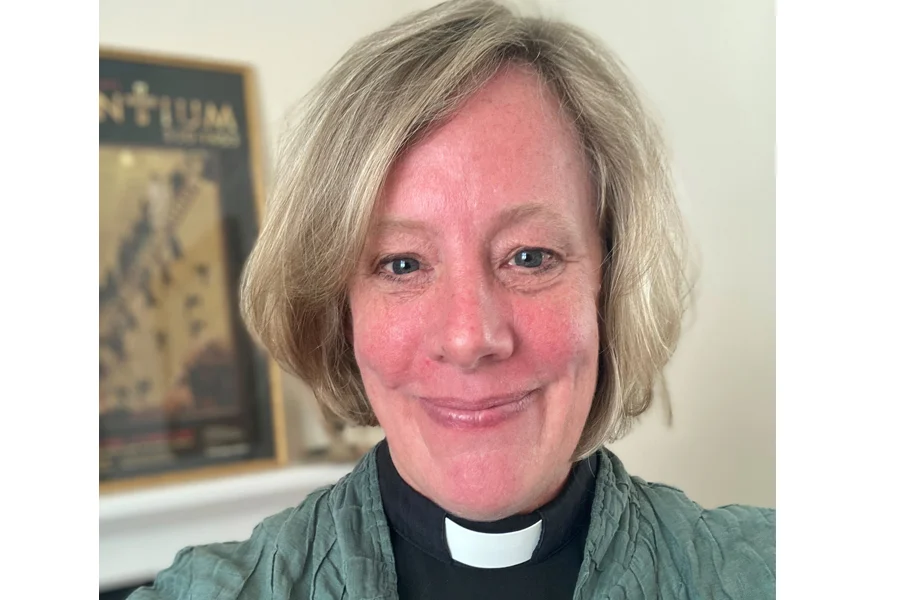
Bishop Hugh has appointed the Revd Fiona Green to be his new Chaplain.
Penny Gordon was ordained Deacon on Sunday 27 September by the Bishop of Dudley, Martin Gorick in a special service…
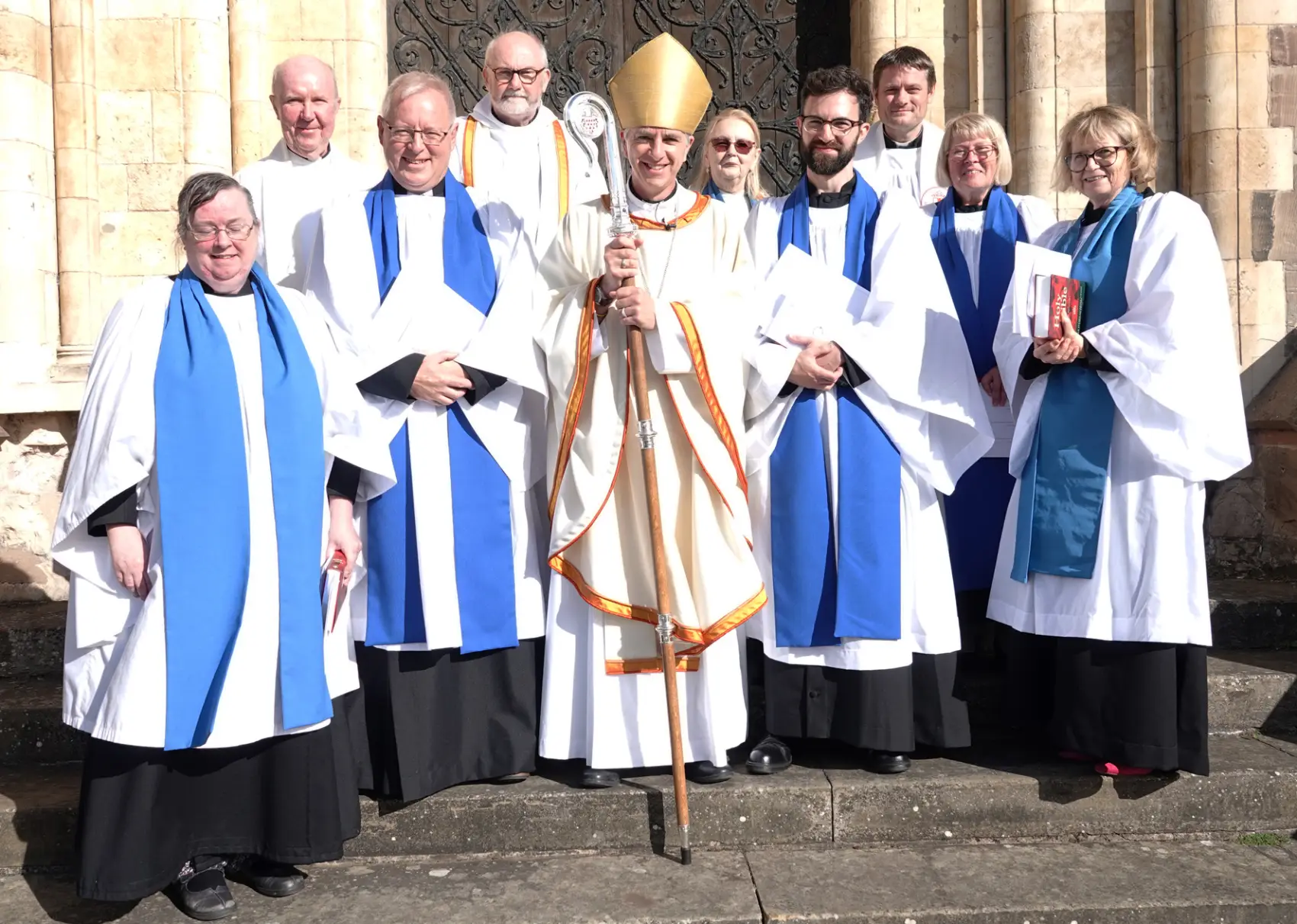
Five people from parishes across the Diocese were admitted to the office of Reader on Saturday in Worcester Cathedral. The…
Curious Hope: Journeying Together into God's Future is the theme of this year's clergy conference. Clergy were joined by our…
Come along to one of a series of gatherings taking place this Autumn for an opportunity to meet with Bishop…
An article from Bishop Martin for October's parish magazines. As I was writing this article in August, the fields and…
On Saturday 15 August, Mike Edwards was licensed as Curate in Charge (to be Priest in Charge) of All Saints…